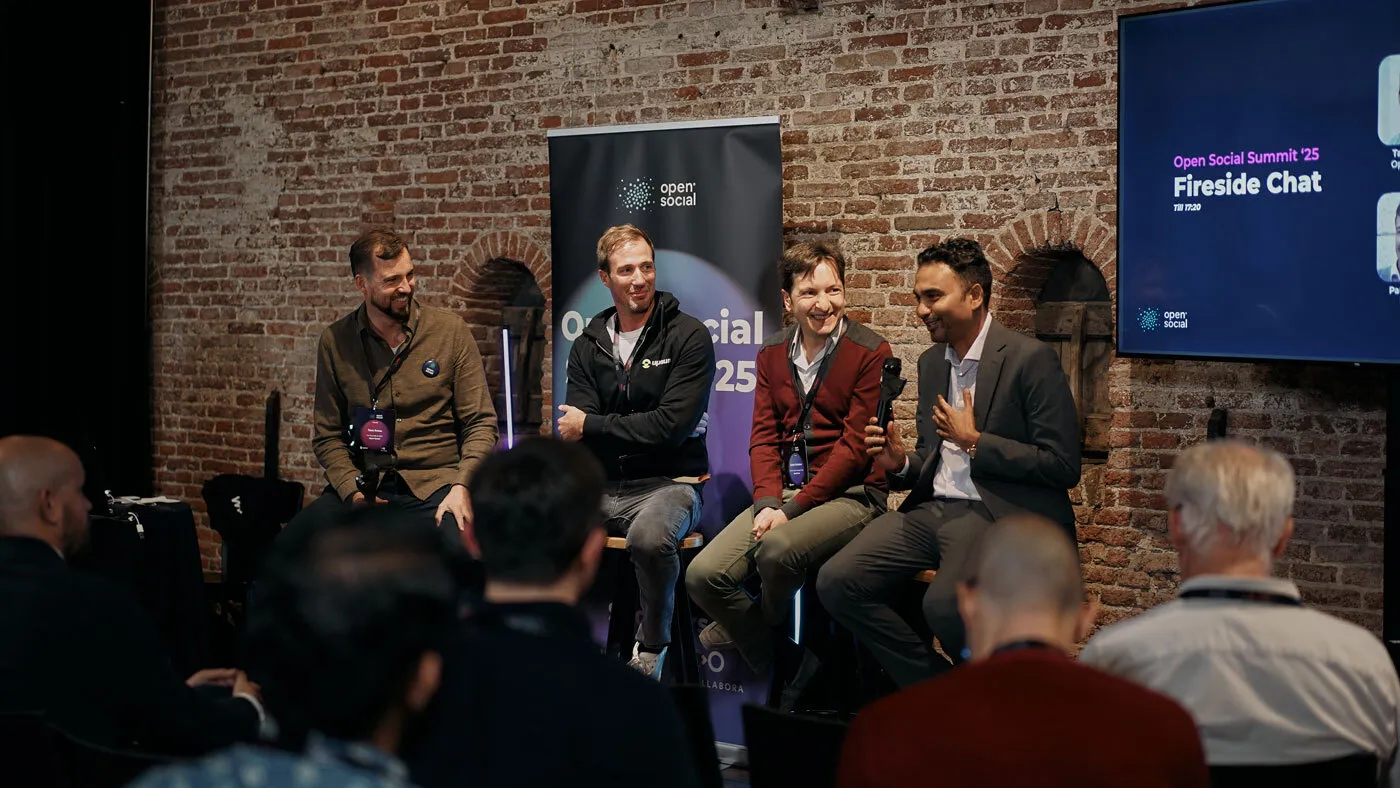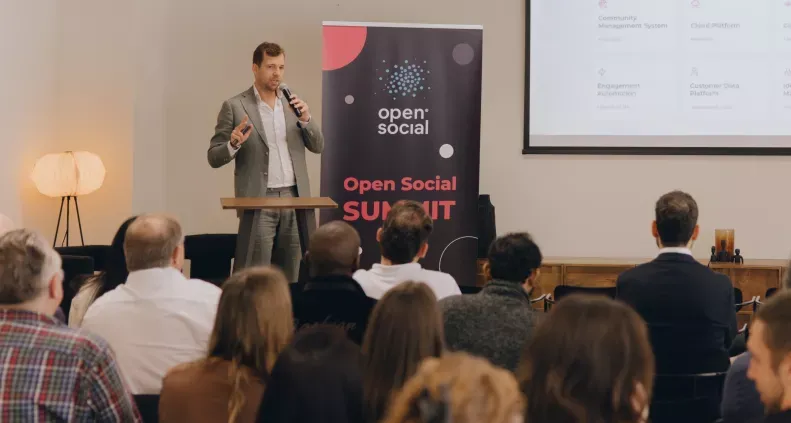
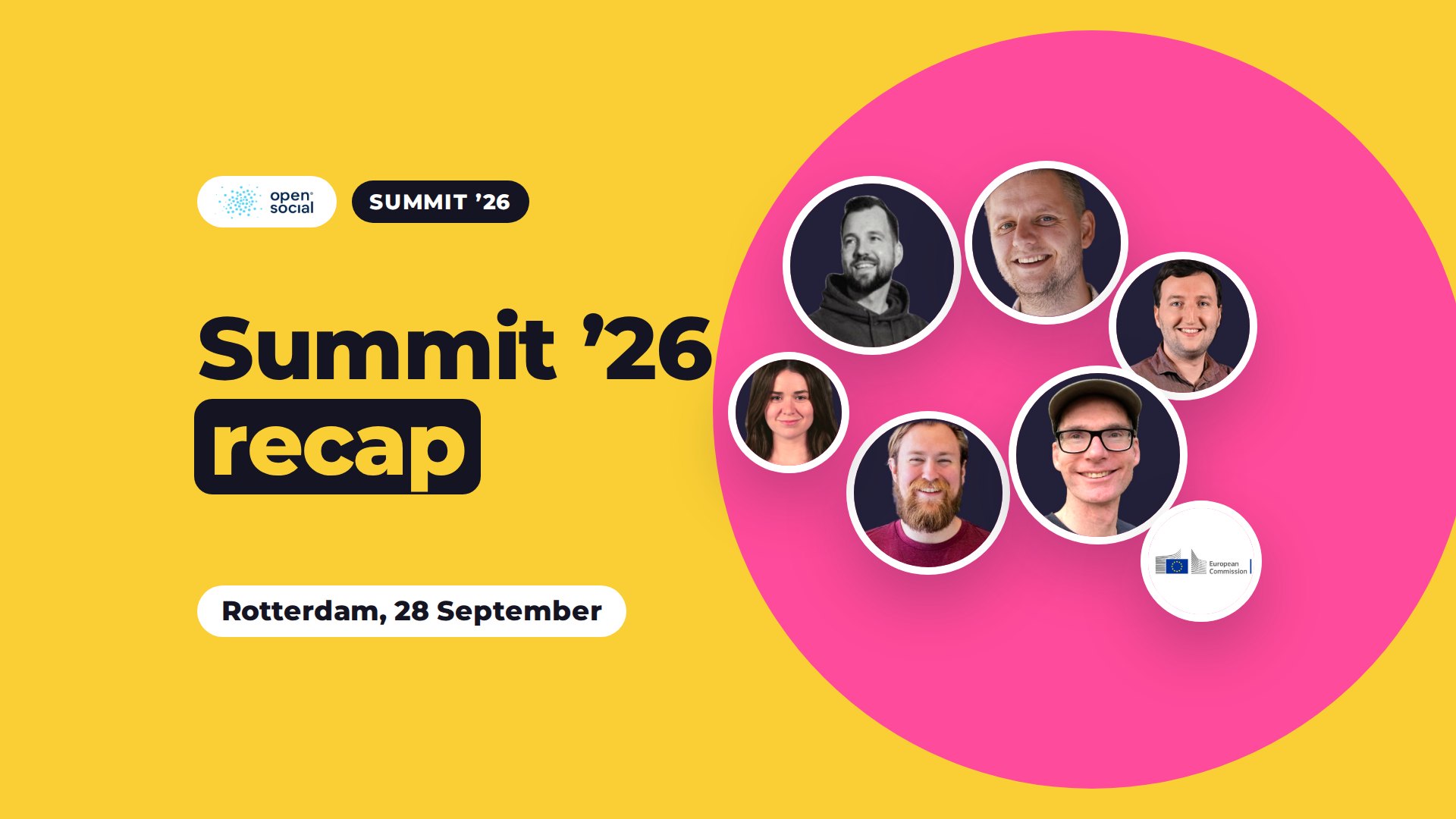
We have published an article for eight of the talks. Here is what each one covers.
Why a network of organisations should own its platform
The opening keynote looked at what changes when collaboration runs across organisations that will never merge: member states, national administrations, consortium partners. Once a network's work becomes its shared memory, three questions become strategic: where that memory lives, who and which AI can reach it, and how the network could move if it had to. The talk closed with three commitments for Summit ’27.
Removing US providers from the mandatory chain: what it took
Open Social has been hosted in Europe for more than ten years, yet two US companies still sat in the path of every request: Cloudflare at the edge and SendGrid for email. Bram explained the move to Bunny and AhaSend, why jurisdiction matters as much as where data is stored, and the three ways organisations can deploy Open Social when they need more control.
What shipped in 2026: making it easier to work together
Bulk file handling, shared document editing with Collabora, online meetings that start from events, affiliations that show who represents which organisation, and weekly releases. Much of it was built with support from the European Commission. Alexander also outlined what comes next, starting with Drupal 11 and Kubernetes support.
Keeping access right in large professional networks
When thousands of people represent hundreds of organisations, access depends on facts that change every day. Moritz showed how segments based on rules keep access, onboarding and communication accurate, with a planned example from IATA, and how they connect to Engagement Studio and Connection Hub.
From meeting to memory: making online meetings part of a network's knowledge
In a live demo, a short BigBlueButton meeting became a transcript, a summary and searchable knowledge on Open Social within minutes. Fred and Taco discussed what this makes possible for a network, and how recording, transcription and AI stay under the network's own control. ELIA will run the first pilot in 2027.
Dashboards and AI: seeing what happens in a network, and understanding why
Lumina Insights shows what happens in a network the same way every time, which is what reporting and audits need. Gaia AI helps explain why, and helps members find knowledge that is already there. Moritz covered what is live, what is rolling out, and how to introduce AI in a community one step at a time.
Lessons from PICS: three years of a collaboration space for customs and tax professionals
PICS connects nearly 5.000 verified professionals from national customs and tax administrations, the European Commission and external experts. Philippe gave an open account of three years on Open Social, what the team learned along the way, and where PICS goes next.
Galaxia: improving the platform one component at a time
Instead of one big redesign, Open Social is improving its interface one component at a time with Galaxia, its design system. Victoria showed what is already live, what comes next for groups, events and content, and how users test every change before it is built.
Also on the programme
The day also included talks by Robyn Gibbs and Paul Bigmore of WAGGGS and by Erik Ballhausen of the European Commission's EACEA.
Thank you to all speakers and participants, and to Upsun for sponsoring the Summit.
See it for yourself
If you run a network of organisations and want to see how this works in practice, request a demo.