
Open Social Summit
From meeting to memory: making online meetings part of a network's knowledge
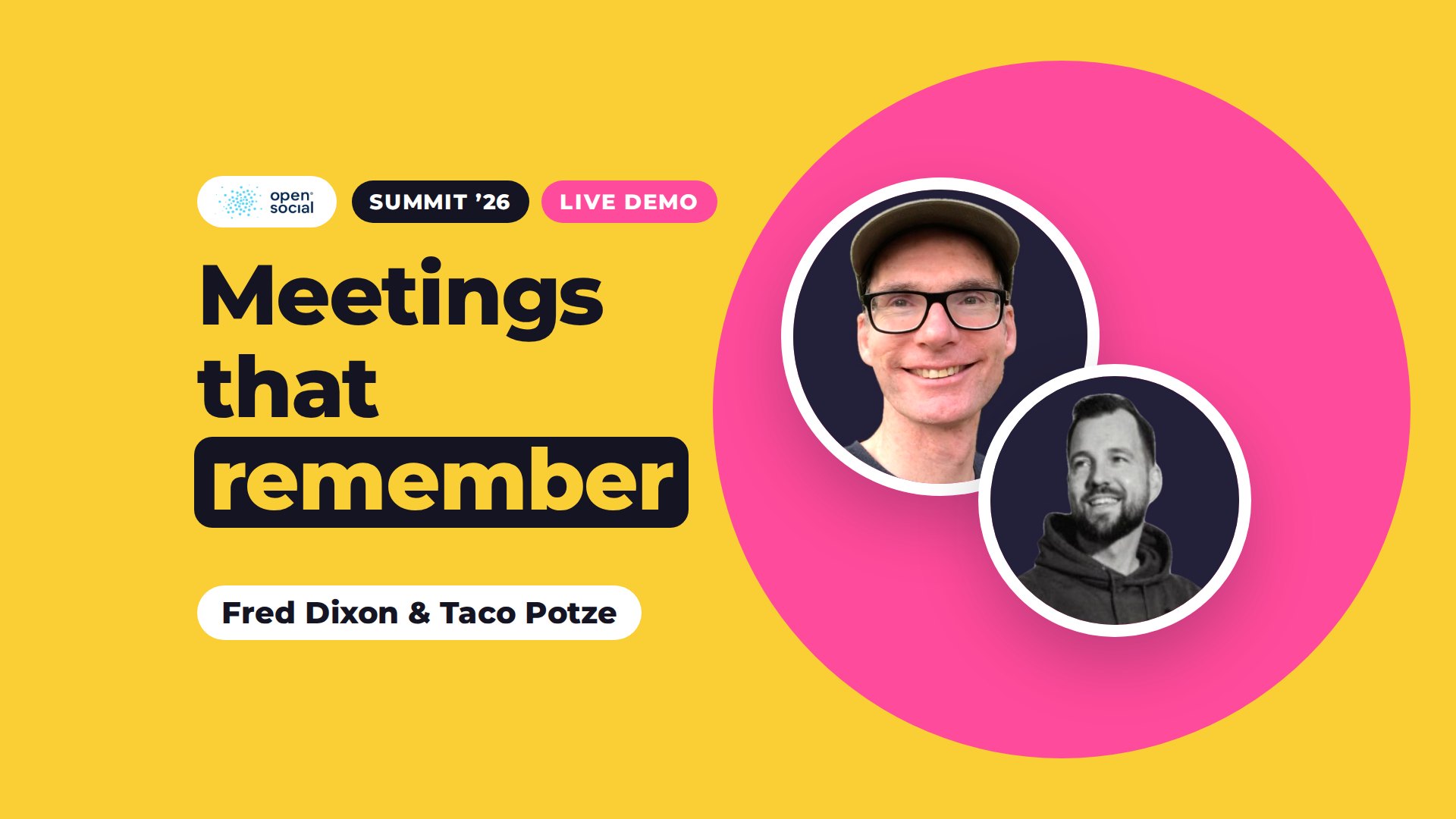
A live demo at Summit '26 showed a BigBlueButton meeting become a transcript, a summary and searchable knowledge on Open Social within minutes.
Many important decisions in a network are made in meetings. Afterwards, that knowledge often stays with the people who attended. Fred Dixon, one of the founders of BigBlueButton and CEO of Blindside Networks, and Taco Potze, CEO of Open Social, showed at the Open Social Summit '26 how online meetings can become part of a network's collective memory.
Open Social + BigBlueButton collaboration
Collaboration has an asynchronous half, the documents, discussions and decisions on a community platform, and a synchronous half, the moments people meet in real time. Open Social supports the first. BigBlueButton, an open source virtual classroom and meeting tool, supports the second. It is used at scale: the French government runs it as its state webinar system, and the European Commission runs it on its own infrastructure.
The two already work together. An Open Social event can start a BigBlueButton meeting with one click for enrolled members, and the recording returns to the event. A recording on its own, though, is hard to use. Few people watch an hour of video to find one decision.
The demo: voice to text means a collective memory
In a live demo, Fred, Taco and Alexander Varwijk held a short meeting from an Open Social event. Minutes later, the event showed the recording, a full transcript with speakers identified, and an AI summary of topics, decisions, action items and attendees. Taco then asked Gaia AI, Open Social's AI search, who backs BigBlueButton. It answered "Blindside Networks", drawing on something Fred had said in the meeting. The only source for that answer was the meeting itself.
This is a proof of concept. It shows that what is said in a meeting can become part of a network's searchable knowledge, available to the people allowed to see it.
What this makes possible
BigBlueButton already captures much more than audio: shared notes, poll results, chat and participation. Brought back to the platform, this can help in several ways. People who missed a meeting can read the decisions and action items. Gaia AI can search meetings alongside documents and discussions. Agendas can build on what is still open. Lumina Insights can include participation in meetings. Organisations facing retirements can record conversations with experienced staff and keep that knowledge accessible.
Control and sovereignty
Turning meetings into knowledge has to stay under the network's control. In the product, event managers will decide per event whether a meeting is recorded, transcribed and summarised, and who can see the results. Both products are open source. Speech to text can run on the same server, so audio does not leave it, and summaries use the AI model the organisation has approved, with Mistral as today's default.
The first pilot
ELIA, the European League of Institutes of the Arts, with more than 280 member institutions in 54 countries, will run the first pilot in 2027. We are open to a small number of additional pilot communities.
See it for yourself
If you run a network of organisations and want to see how this works in practice, request a demo.
Related articles
You might find this interesting too.

Connect. Collaborate. Thrive.