
Open Social Summit
One entry point, 6 communities: how EACEA runs its networks on Open Social
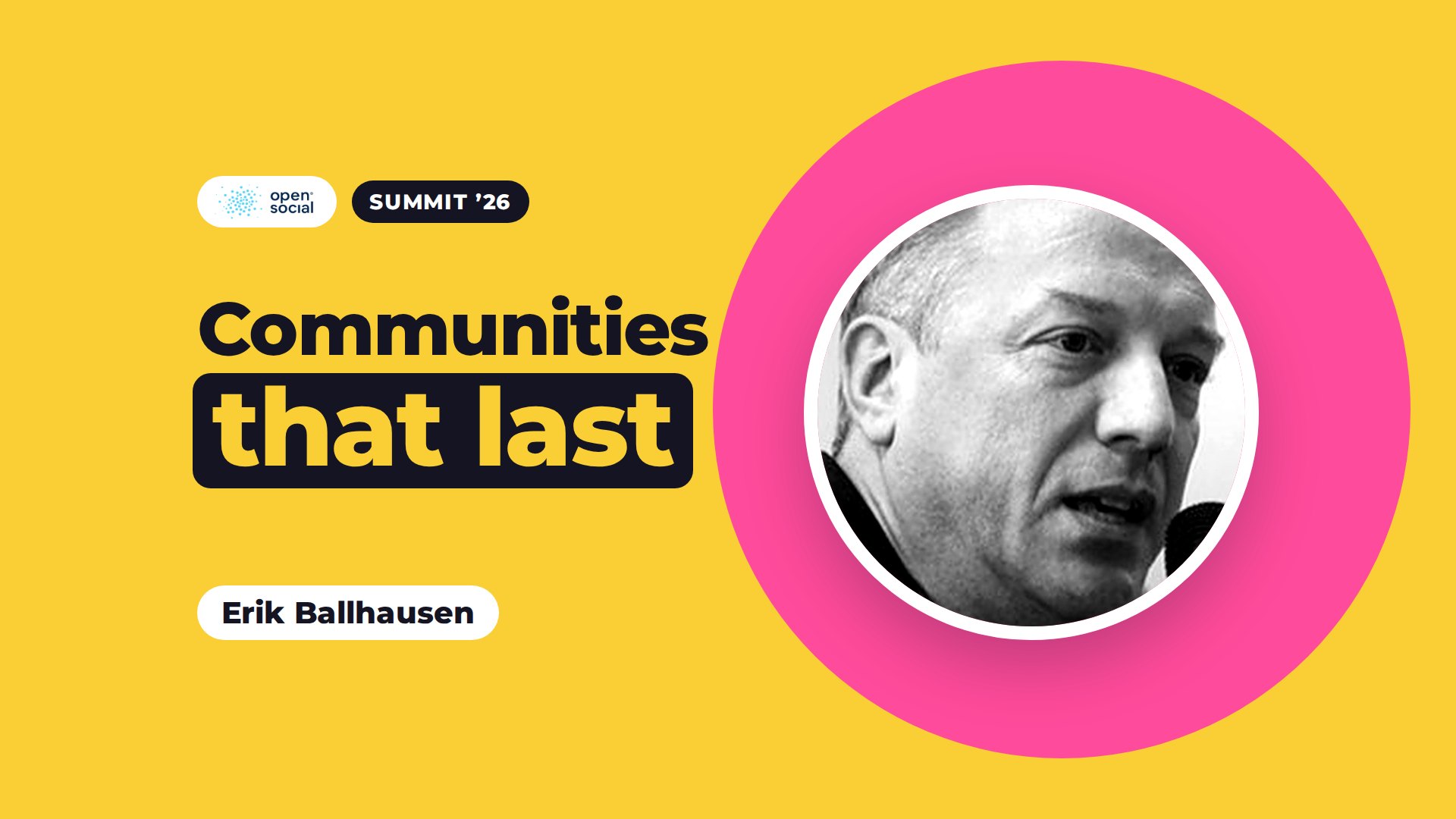
Erik Ballhausen of the European Commission's EACEA on its community playbook, bringing Erasmus+ networks into one place, and why members should set the vision.
The European Education and Culture Executive Agency (EACEA) implements programmes such as Erasmus+, while the Commission's Directorates General set the policy. Erik Ballhausen, community management expert at EACEA, explained at the Open Social Summit '26 how the agency builds and runs communities, and why it brings them together on one platform.
A playbook for community management
Many managers still see communities as unnecessary: there is email, and there are meetings. To make the case, a community of practitioners at the Commission developed the Communities of Practice Playbook, based on research by the Joint Research Centre. It covers the full life of a community, from the idea and the setup to onboarding and long term management, and it changes with time: onboarding in year one, with no members yet, looks very different from onboarding in year five.
The playbook also insists on clear concepts. A network is not a community, and cooperation is not collaboration. Teams that try to do both at once tend to fail. Everything in it is open source, and the Commission has turned it into practical tools: a checklist, a roadmap tool, a barometer for existing communities and a digital compass for online communities.
Members set the vision
Because the communities are funded with public money, each one must clearly support the programme. But the vision itself comes from the members. When the European Digital Education Hub reached about 150 interested people, they were invited to an online design workshop and agreed on a shared vision in an hour and a half. A community only works when members see what it adds for them.
One entry point
EACEA's long term strategy is a single entry point. The Erasmus Networks Platform started with two closed networks, including the national focal points in the member states, who used to coordinate by email. Others followed, such as the worldwide network of Erasmus Mundus ambassadors. Study in Europe, previously a separate website, moved in as public information, so that open and closed content sit side by side.
More is on the way. The European Digital Education Hub, which started in Microsoft Teams during the pandemic and grew past 9.000 members, is moving to the platform after a successful pilot. An Erasmus alumni community, with potentially a million former exchange students, is being launched. Creative Europe MEDIA plans to replace a website for its presence at Cannes with a community that is active for a few months around the festival.
Same platform, different communities
Each network configures its own landing page. One leads with activities, another with a spotlight on upcoming events, another with working groups, frequently asked questions and a calendar. Members find what they need without having to search. Education4Climate, a public community of around 10.000 members across all levels of education, found that a podcast on Spotify brought new members in: in a community, good content pulls people in rather than being pushed out.
Who does what
Running communities at this scale involves several parties. Operational units own the programmes. DG DIGIT provides the platform as a corporate service, including EU Login and security. Larger communities are managed by contractors selected through tenders. Open Social advises on the best setup, and Erik works as the link between them. When a first concept did not work, the teams reversed it together and had the right one two months later. As Erik put it, it is not the usual contractor relationship: "it's a dialogue".
See it for yourself
If you run a network of organisations and want to see how this works in practice, request a demo.
Related articles
You might find this interesting too.

Connect. Collaborate. Thrive.